Custom Work Jackets for Teams & Businesses | RaceApparelCUS

Custom Work Jackets for Businesses and Trade Teams: The Complete Buyer’s Guide
Prior to the renewal of a large contract for management services, a company providing management services ordered (80) custom track jackets to be worn by staff members. The jackets had arrived on or before the stated deadline, and the company was satisfied with the image quality of the logos as shown in the photo(s) of the product(s) printed on the jackets; however, after only two (2) weeks of receiving them and wearing them every day (Monday to Friday), twelve (12) of the employees working in the warehouse reported that the zipper at the bottom had already separated from the jacket.
The client had their reputation destroyed by receiving defective products from their supplier regardless of whether or not those defective products were subsequently replaced by the same supplier; branded workwear is used daily at the client’s location; if that branded workwear fails while in front of the client’s customers, it reflects poorly on the business that ordered the branded workwear.
This guide explains the essential elements to consider while ordering a custom work jacket. You will learn about the fabrics used in manufacturing the jackets as well as the standard methods of constructing jackets. We will discuss ways to brand your product, how you should plan your size run, and finding a manufacturer that will stand behind their promise. No matter if you are ordering jackets for a single trade team of 30 or for an entire national workforce of 3,000, you are making the same decisions.
1. What Counts as a Work Jacket — and Why It Matters for Ordering
The term ‘work jacket’ covers many types of outerwear that all can be described as having the same function, making ordering extremely confusing. A facilities tech uses a work jacket for repairing items and building maintenance, while an account manager uses a work jacket more for customer interaction and brand representation, two very different functional needs.
Define what a work jacket means to you before you contact a manufacturer.
• Is your work jacket going to be used in a controlled indoor environment, or will it be used outside in unpredictable weather?
• How important is that this jacket complies with safety regulations? Is high visibility important to you?
• Is this going to be used as a replacement or an addition to current employee uniforms?
• Is this going to be seen as a professional brand layer for market facing employees or a functional outer layer for trades employees?
•Does the design of the item need to include provision for body armor and/or tools/loops and/or other job related equipment?
The responses determine the jacket type, fabric specification, construction standard, and branding method. A manufacturer that does not ask these questions before quoting is creating a generic product (not a custom-made work jacket designed for your workforce).
2. Types of Custom Work Jackets
These are the main jacket types used in workplace and trade environments, each suited to different working conditions and branding requirements.
Softshell Work Jacket
Work jackets come in many different styles but the softshell is by far the most flexible and widely ordered type work jacket. A softshell provides a wind resistant shell with a fleece or bonded lining that provides warmth yet allows for a less bulky garment than a traditional padded jacket. The softshell is suitable for both indoor office settings as well as many outdoor job sites, making it appropriate for use at client-facing businesses as well. The softshell is clean and presentable enough for use by front-of-house staff and yet functional enough for outdoor work teams in the construction trades. The softshell is the preferred choice of many businesses looking for one jacket to use in multiple types of settings.
Padded Work Jacket
Typically made from polyester batting, synthetic fills (commonly 80 to 200 g) are used for cold weather applications in order to create insulation. Workers, such as construction workers, logistics support, outdoor maintenance personnel, and all others who must work extensively outdoors during winter months, will don this type of insulated jacket. Although they are heavier than soft shells, they have seen a tremendous increase in their warmth-to-weight ratio when compared to older insulation products due to the development and introduction of modern insulation materials.
Fleece Work Jacket
A mid-layer is designed to be worn over a base layer and beneath a shell jacket, though it can also be worn standalone in warmer temperatures. Fleece jackets are commonly used by employees in warehouses who are working in and out of temperature-controlled areas. Fleece jackets are lightweight, quick-drying, and can be easily customized with an embroidered design.
Waterproof Shell Jacket
An outer layer that is 100 percent waterproof is a requirement for those who work outdoors in wet or rainy conditions for long periods of time (construction; grounds maintenance; utility work; agriculture, etc.). Outer layers made with two-layer or three-layer bonded construction usually have taped seams and a durable water repellent (DWR) finish on the outer fabric. While these outer layers are generally heavier and more expensive to manufacture than a softshell, they are the only option in the true sense of being ‘in the wet’, for work performed in extremely wet environments.
High-Visibility Work Jacket
An EN ISO20471 (or equivalent national standard) requires that all workers who work close to moving vehicles or machinery wear reflective tape in the correct position and have sufficient fluorescent fabric area to comply. If you purchase a hi-vis jacket without confirming compliance with your country’s current regulations, you could be making a costly mistake regarding compliance with the law.
Lightweight Branded Work Jacket
This will be a clean and smart-looking outer layer for all staff that engage with clients. We expect to see this worn by account managers, field sales team members, service engineers, and hospitality supervisors. These jackets are typically made with either a softshell or thin-shell material and are cut in a tailored style. When designing the jacket, the priority should be to make the jacket appear professional and include a logo, rather than for weather resistance.
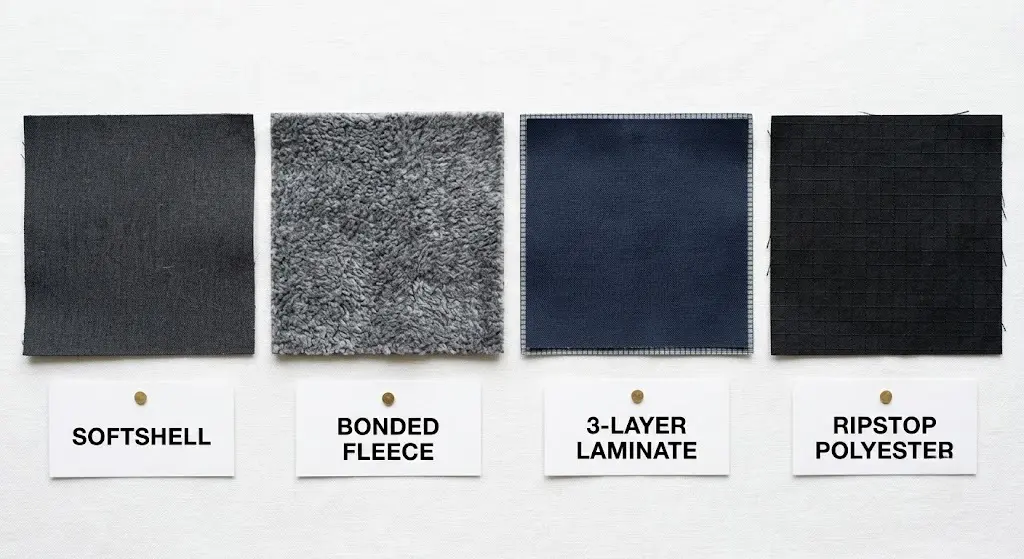
3. Fabric and Construction Standards for Workwear
Workwear fabric is subjected to more abuse than leisure or sports clothing. Daily wear, frequent washing, contact to tools and surfaces; the elements – all cause low-quality materials to degrade quickly, far sooner than what the manufacturer claims on its marketing materials.
| Fabric Type | GSM Range | Best Work Application | Key Property |
| Polyester Softshell | 270–350 gsm | General trade, outdoor site work | Wind resistance + stretch |
| Bonded Fleece Softshell | 280–380 gsm | Cold-climate outdoor work, logistics | Wind block + warmth |
| 3-Layer Laminate | 150–250 gsm | Waterproof shell, exposed outdoor roles | Full waterproofing + breathability |
| Polyester Fleece | 180–280 gsm | Warehouse, mid-layer, mild outdoor | Lightweight warmth, quick-dry |
| Ripstop Polyester | 120–180 gsm | High-wear environments, site work | Tear resistance + durability |
| Recycled Polyester | 200–320 gsm | Sustainability-focused organisations | Lower carbon, OEKO-TEX certifiable |
In addition to fabric weight, the workmanship in the construction of a workwear jacket influences its ability to hold up to daily use:
- Stress points (e.g., elbows, cuffs, and openings) of any garment made from a chain store or department store will usually be the first areas to show wear due to the poor quality of the product.
• Zippers made by YKK or equivalent-quality brands are often the most common point of failure with lower costs when it comes to truly “budget” workwear. - Bar-tack stitching on the corners of pockets and along the ends of zippers provides extra strength against ripping from frequent use.
Organizations that have supply chain compliance needs can use OEKO-TEX Standards for Shell and Lining (oeko-tex.com) to document that their shell and lining fabrics meet safe human ecological safety requirements which are becoming increasingly important to procurement teams working in the public sector and regulated industries.
.
4. Branding and Logo Options for Work Jackets
Selecting the best method for branding your workwear will be dependent on several factors including the type of fabric used, level of complexity in the design, and way in which the garment will be utilized. Each method outlined below has its own unique positional context in relation to professional clothing branding.
Embroidery
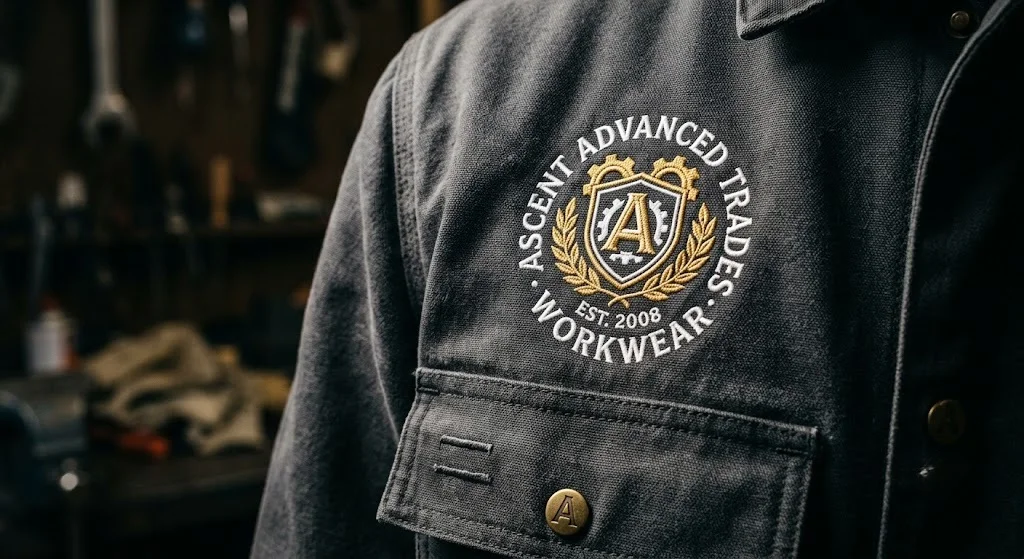
The standard for branding professional workwear includes durability, feel, and wash resistance through the most demanding washing cycles. Embroidered logos work much better than other methods (screen printing / transfers) because they display a higher-quality image that is important for client-facing employees. Our recommended locations for embroidery placement are on the left breast (primary logo) and right breast (secondary logo) with an option to add a sleeve or back yoke placement; our recommendation is back yoke.
Screen Printing
When it comes to high-volume purchases, screen printing is typically less expensive than embroidering. This method of printing creates excellent large back graphics and bold designs applied to thinner material. The application of this type of printing on soft or fleece clothing is not recommended because of the texture’s requirement for pre-treatment prior to printing, which can decrease the amount of detail that can be printed. If the final cost of a clothing (budget) order is more important than the quality or appearance of the clothing, then screen print is the ideal printing method for the project.
Heat Transfer / Digital Print
This method is allowed for logos that need fine detail, gradient colors, and/or photographic elements as well as for small quantities where setup costs for a screen print would not be justified. This type of logo will not be as durable when it goes through industrial wash, Relevant if jackets are going through a commercial laundry cycle instead of a typical home wash.
Reflective Logo Printing
For workwear or environments where safety is a concern, logos and text can be printed on branded reflective materials. The reflective logo/text is visible at night when illuminated by vehicle headlights or site lighting. The combination of safety visibility and branding does not mean that the company’s product must be manufactured in accordance with a full hi viz jacket specification.
Woven Labels and Custom Trims
Private-label workwear programs should include custom neck labels, internal care labels, and branded zip pullers to create a unique product rather than a generic jacket with a logo. These will create true ownership of the product.
| Branding Method | Min Qty | Best For | Durability Under Washing |
| Embroidery | 30+ units | Professional workwear, client-facing staff | Excellent — 100+ washes |
| Screen Print | 100+ units | High-volume trade workwear, back prints | Good — 50–80 washes |
| Heat Transfer | 20+ units | Complex logos, small batches | Moderate — 30–50 washes |
| Reflective Print | 50+ units | Safety environments, hi-vis jackets | Good — EN ISO tested |
| Woven Labels | Any (added to order) | Private label workwear programs | Permanent |
5. How to Order Custom Work Jackets in Bulk
Compared to sportswear/lifestyle apparel orders, workwear orders have a larger range of variables involved, including: A Larger Workforce Size; A Broader Size Distribution; Increased Durability Requirements; Complex Compliance Obligations. Getting it right prior to production is not just important for maintaining the integrity of the project, but also differentiates an order that can be completed effectively from an order that will require 2x the original cost to fix.
Step 1 — Define the Functional Specification
You’re going to want to resolve the functional brief first, including the jacket type, fabric specs, safety standards (where applicable), size range, gender specific cuts if necessary, and color before you start thinking about logos. Every decision you make downstream pertaining to branding method, customization options, lead time, and unit cost is reliant on the functional brief specifications you set here.
Step 2 — Conduct a Workforce Size Survey
Prior to ordering jackets, it’s best to first send size surveys out to every staff member who will receive one. By setting up a quick form that requests their name, department and size preference, you’ll have a quick way to eliminate the most-costly guessing game in workwear procurement. Companies that fail to do this always end up with incorrect sizes, and the cost of replacing incorrectly sized jackets is far greater than that of creating an original order.
Step 3 — Prepare and Approve Artwork
Your company logo must be supplied as a vector file (.ai or .eps) in the specified Pantone colors. For embroidered logos, the logo must be into an embroidery file (usually done by the manufacturer) and you will want to see and approve the file prior to having it produced. Small features such as thin lines, small type and gradients do not always transfer into an embroidered logo well and may require simplification — it is best to discover this during the phase rather than after you have 200 jackets embroidered.
Step 4 — Request a Physical Sample with Branding
A pre-production sample will show the actual embroidery or print that will occur on your order. Confirm construction of a jacket, how the fabric feels, how accurately the logo is placed and how closely the color matches your approved standards and brand. You must approve the sample in writing prior to starting bulk production.
Step 5 — Confirm Delivery Logistics
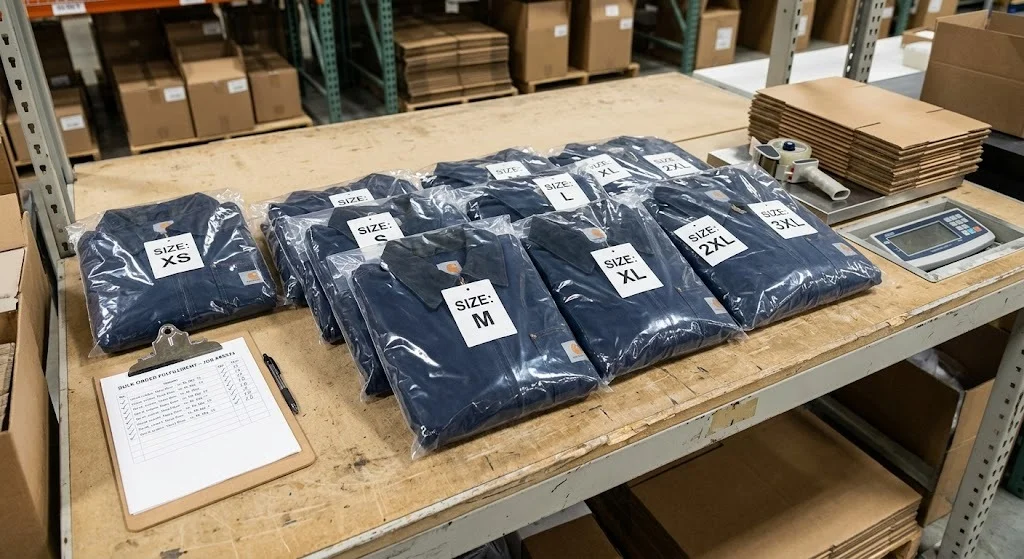
When ordering workwear from manufacturers for a large group of employees, you will typically have to collect individual packs by employee name or department. Before the order is produced, verify with the vendor if they will pre-pack the items correctly; sorting at the factory will take less time than unpacking and re-sorting four hundred jackets at your warehouse after the product has arrived. Confirm how the order will be shipped — whether in one shipment or multiple shipments — and clarify how customs and taxes will be handled for international shipments.
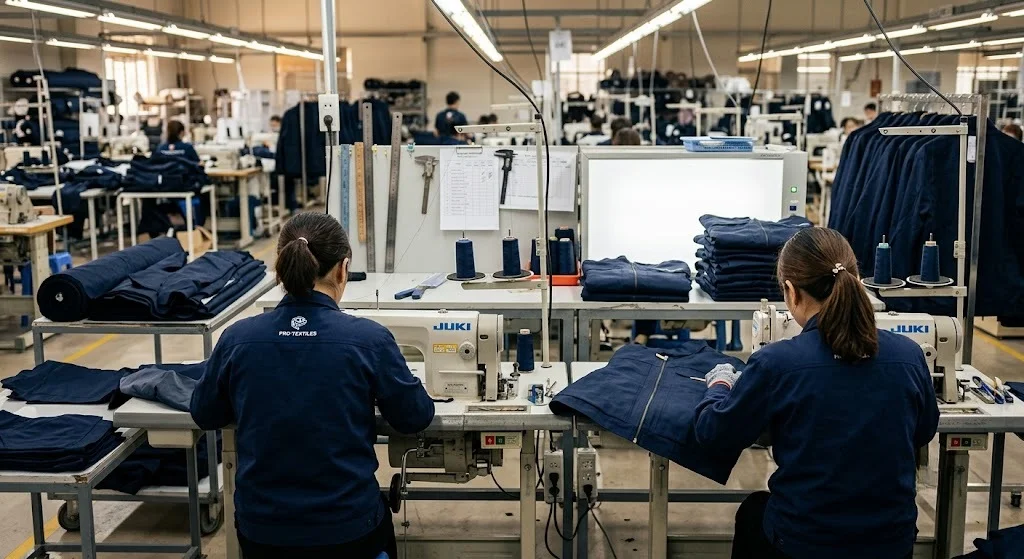
RaceApparelCUS has provided an overview of their custom jacket manufacturing process in an OEM environment that includes detailed information about the different steps involved in the initial stages of manufacturing custom jackets (sampling, return to quality control, bulk order fulfillment) for businesses or trades.
Ready to get started? Work with a specialist custom jacket manufacturer and get your free quote in 10 minutes.
6. Size Run Planning for a Workforce
Workwear sizes vary a lot compared to sports team orders in that they generally have a much larger range of ages, body types, and genders, and there is naturally a greater ratio of people at the large end of the sizing scale than in a competitive sports team.
| Size | Typical Workforce % | Notes |
| XS | 2–5% | Lower in trade and construction environments |
| S | 8–12% | Higher in hospitality and office environments |
| M | 20–25% | Consistent across most workforce types |
| L | 25–30% | Usually the single largest size in most orders |
| XL | 20–25% | Higher in construction, logistics, and manufacturing |
| 2XL | 10–15% | Higher in physical trade roles |
| 3XL+ | 3–8% | Confirm availability with manufacturer before ordering |
The values listed in this table should be considered initial benchmarks; they do not replace the actual measurements taken from your specific workforce. If the distribution is off by ten percent based on an industry average of three hundred jackets, then you will have thirty unusable jackets.
Confirm that the manufacturer produces garments in size 3XL or larger. Some factories will only produce garments in size 2XL, making it impossible to support employees working outside of this size. Ask your factory to send you their full-size specification sheet before you approve your sample.
7. Compliance, Safety Standards, and Certification
For businesses in regulated industries such as construction, utilities, transportation, manufacturing and the public sector workwear isn’t simply a branding exercise, but it can also be mandatory for compliance purposes, including specific performance standards.
High-Visibility Standards
Hi-visibility (hi-vis) outer layers will usually be required for workers that work around moving vehicles or machinery to comply with EN ISO 20471 (Europe) or ANSI/ISEA 107 (North America). The standards define the minimum area of fluorescent background material as well as the pattern and position of retro-reflective tape. A jacket that is considered hi-vis but has not been tested and certified to the appropriate standard does not meet the legal requirements.
Flame-Resistant Workwear
In industries that have a risk of fire or arc flash such as the oil and gas, electrical, or welding industries the outer layer of personal protective equipment must also meet the EN ISO 11612 standard or the EN 61482 standard. Standard polyester and nylon shell fabrics do not have flame resist characteristics. Ordering standard workwear in these types of environments is a failure to meet health and safety requirements and is simply a specification error.
General Fabric Compliance
In the case of organizations that require supply chain due diligence, having documentation relating to the sources of the fabric is very important. The following ISO textile testing standards will provide a methodology of determining the characteristics of the fabric: performance, colorfastness and dimensional stability. Suppliers that have the ability to produce test certificates aligned with these standards will be working to a documented standard of quality and not simply providing a verbal commitment of quality.
Do not place your order for workwear without checking first if there is an obligation to have the jacket certified to a particular standard” says Health & Safety. Anything that does need to be certified must appear on your purchase order, and not leave room for assumptions.
8. Common Mistakes When Ordering Branded Workwear
Not Specifying the Washing Requirement
Leisure clothing is usually washed less often and at cooler water than work clothes. Therefore, if a work jacket is intended for domestic wash and you put it into a commercial wash it will wear out much faster than if you used it according to its intended domestic application. Be sure to include this information in your specifications to the manufacturer if you are going to be using a laundry service or are going to be washing your jackets at 60 degrees Celsius (140 degrees Fahrenheit) or hotter — the manufacturer can suggest which fabric weights and methods of branding will withstand these washing conditions.
Ordering All the Same Cut
A one-size-fits-all unisex pattern designed for men does not provide an equitable solution in terms of fit and style for a workforce made up mutually of men and women. Women who wear these jackets cut to men’s specifications find the look unprofessional, as well as making them uncomfortable to wear or work in. If possible, provide both a fitted and un-fitted option as part of your survey to gain feedback from both your male and female employees. The cost of providing both options is negligible compared to having a high percentage of your employees not wearing the jackets due to improper fit.
Skipping the Pre-Production Sample
For workwear, the sample stage is essential. All aspects of fabric feel, construction weight, and logo placement must be physically verified before finalizing any bulk orders. An example of why the above is important is to show that your non-branded workwear jacket may look good in a graphic render but feel bad when you wear it. The more jackets or other products that you order, the greater the effect.
Underestimating Replacement Requirements
The durability of workwear will vary amongst employees, generally determined by usage. For example, a jacket ordered this year for your 200 employees will probably need to be partially replaced within the shortest period of 12–18 months due to being worn frequently and thus reaching its natural end of life. Therefore, it is wise to establish a standing replacement order with the manufacturer as part of your initial order — and be assured that any orders placed after the initial order can be produced from the same style, fabric, and color through each production run.
9. Choosing the Right Manufacturer
The brand choice by the manufacturer is the foundation for all other things — from product quality, timelines, and branding accuracy — to even the company’s final product. The way that a factory that makes outerwear (outerwear) and custom workwear (custom workwear) is designed is completely different than the way that a factory that produces all other kinds of garments is designed, and this difference will be visible in the final product produced.
Based on over a decade of production experience in custom outerwear manufacturing, the questions that consistently separate capable workwear manufacturers from unreliable ones are:
- Could you send some examples of past jobs showing the products we’re interested in and how many items were completed?
- What is your procedure for inspecting and approving fabrics before they enter your facility for production, during production and before they are shipped to us?
- Are you able to provide any certificates of testing or compliance (to approved industry standards) for the fabrics we will be using?
- What is your process for color consistency across repeat production runs?
- How do you handle size replacements and post-delivery issues?
Manufacturers who answer these questions clearly and specifically are operating a professional process. Manufacturers who give vague reassurances without documentation are not.
Producing and providing authorized manufacturer of Custom Leather Jackets along with Professional Work Wear to Businesses, Trade Organizations and Private Label Firms. Factory Direct (OEM) Manufacturing (No Minimum Order) Embroidery & Screen Printing Available (All in House). 3 Stages of Quality Control Documented between Sample Approval and Pre-Shipment Inspection have been established.
Frequently Asked Questions
What is the minimum order quantity for custom work jackets?
The manufacturer and decoration method both influence the minimum order quantity (MOQ). Typically, embroidered work jackets can be ordered in quantities of thirty, while screen-printed styles usually require more than one hundred units to be economically viable. Some original equipment manufacturers (OEMs), such as RaceApparelCUS, do not have an MOQ; please verify directly with them before assuming that you must commit to a large initial order.
How long does it take to produce custom work jackets?
If you are looking for a timeframe for order placement to delivery, it takes approximately 8-12 weeks from confirmed order to delivery. Sample production takes between two to three weeks to complete and bulk production is three to five weeks from sample approval to production completion. Once your product has been manufactured, it will take between one and four weeks for the international freight method of delivery to reach your final destination. All workwear orders with printed individual names or department packing require additional production time; please allow for this when you are placing your order.
Can I get different jacket types in the same order?
Yes, it is common for an organization to order several types of jackets during a production run. For example, they may order different types of jackets such as warm outdoor jackets that would be used by workers who work outside and softshell jackets that would be used by office staff, but all would have the same logo on them. Confirm with your manufacturer that the branding method will be consistent on all types of fabric being ordered (both fabrics will have embroidery as a branding method; not all print methods will work on both fabrics).
Do work jackets need to meet safety standards?
The working conditions will determine the clothing required by workers. Those whose work involves being around either moving vehicles or machinery generally require the use of EN ISO 20471-certified hi-visibility outerwear in the workplace. Workers who work in areas that present the danger of either fire or electric arc flash hazards require flame-resistant certified jackets to meet their necessary safety needs. Standards do not apply to the traditional office and retail/service workplace.
How do I ensure logo colors match my brand standards across repeat orders?
Rather than using RGB or hex references, provide Pantone color codes. Pantone is the industry standard for dye and thread matching used in garment manufacturing. Keep a sample from your original order as your color standard for all future production orders and continue to use that color as your source for repeat orders. Always get a color swatch from your manufacturer, before you start any large-run orders, to be sure you are getting the same color every time.
Can I order work jackets in multiple colors for different departments?
Affirmative. Ordering multiple colors of the same jacket style in one purchase order is generally done as normal. However, you should determine whether the MOQ applies to each color or to the combined quantity of all styles and colors before making your order, as this will have a major impact on your minimum.
What is the difference between OEM and private label workwear manufacturing?
OEM allows you to give the factory specifications and artwork to create the exact product you envision; private label allows you to take an existing jacket design from a manufacturer and put your own logo on it. For branded workwear programs using the OEM model, buy will have more control over the manufacturer's ability to produce an approved product, and they will also have assurance that the manufacturer has followed product specifications/standards set forth in the OEM contract. If an entity does not have a technical capability for designing a product or needs to expedite procurement, they would benefit from using private label manufacturing.
How should I handle size replacements after the initial order?
Before placing the initial order, have a plan for a standing replacement program. Then confirm with your manufacturer that they will be able to produce the same style, fabric color and construction characteristics consistently throughout the whole production run. Maintain at least some minimum stock of the most frequently requested sizes (generally, M, L and XL) on hand to provide quick replacements for new workers and worn-out products instead of waiting for minimum order quantities on replacement runs.
Ready to Order Custom Work Jackets for Your Team?
Your employees will not only be kept warm and protected by a quality work jacket, but they’ll also see your branding whenever they come into contact with customers. For both to be successful, you must have firm specifications and manufacturers who can tell the difference between generic and tailored workwear to suit your business needs.
RaceApparelCUS manufactures custom work jackets for commercial clients, sporting associations, as well as private-label apparel programs. We manufacture everything through OEM direct from the factory, have no minimum order requirements, provide full embroidery and print capabilities, and we maintain a quality assurance process that includes 3 stages from the sample stage to completion of production.
Get a free quote in 10 minutes — contact RaceApparelCUS directly.
