Custom Varsity Jacket with Chenille Patch | RaceApparelCUS

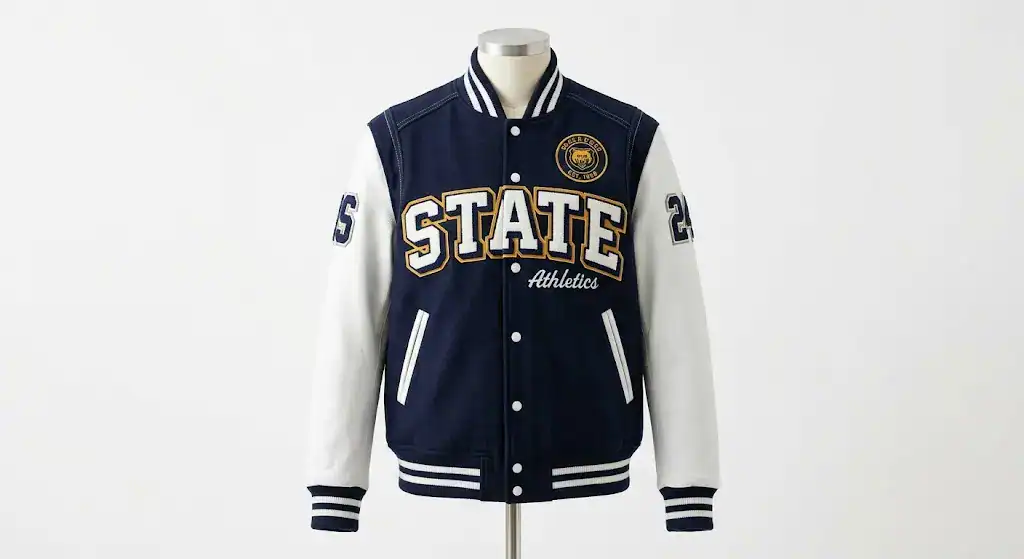
When a streetwear label commissioned their first custom varsity jacket from an external vendor who had subcontracted out the chenille patches to another factory, they initially received the jacket body before receiving the patches two weeks later, from another country, whose backing was 0.4mm thicker than the wool body of the jacket could handle. This difference caused the sewing operators to raise a red flag regarding how the patch would not sit flat and instead form a visible ridge on the chest area, pulling in some of the wool at the seam point where they would be attached. As a result, the production process was delayed by three additional weeks due to the need for reordering patches, thus missing their release date for the season’s collection. The first question that needs to be asked when looking into any custom varsity jacket with chenille patch is whether the manufacturer produces both components in-house.
From Design to Delivery: How a Custom Varsity Jacket with Chenille Patch Gets Made
What a Chenille Patch Actually Is
The following structural features should be considered in high-quality chenille patches:
- There is felt back to provide stability and neat edges that will allow easy sewing on the jacket;
- Appropriate density of yarn is used – usually, it is acrylic, but wool may be used for better-quality chenille patches;
- Controlling the pile height – the height of the pile depends on its length which ranges between 4-6 mm;
- Sewing the outlines of the patch through flat embroidery.
First misconception: Chenille patches aren’t the same as embroidered patches, and the price difference comes from the difference in process involved. The embroidered patch can be created faster and with less equipment and thread needed. The chenille patch requires being made on toweling embroidery machines; it takes longer to make each individual patch and requires that the loop height be perfectly adjusted. However, it’s definitely worth it, as it adds a grace and weightiness to your wool body jacket patches that simply cannot be matched by embroidered patches. Just remember to compare like-for-like when requesting a quote.
Stage 1 — Design File and Artwork Preparation
Prior to producing any patches, the design will first have to be converted to a language the embroidery machine understands. This is the phase which many clients underrate, but this is also the point where many rejections start to happen.
The following are the requirements for making your patches:
- Artwork vector file (either .ai or .eps file) with proper closed paths
- Pantone color codes for all colors utilized in the design
- Size of the patch (inches or centimeters)
- Information about thin lines, small texts, or gradient lines which may have to be simplified
Stage 2 — Digitizing the Design for Embroidery Production
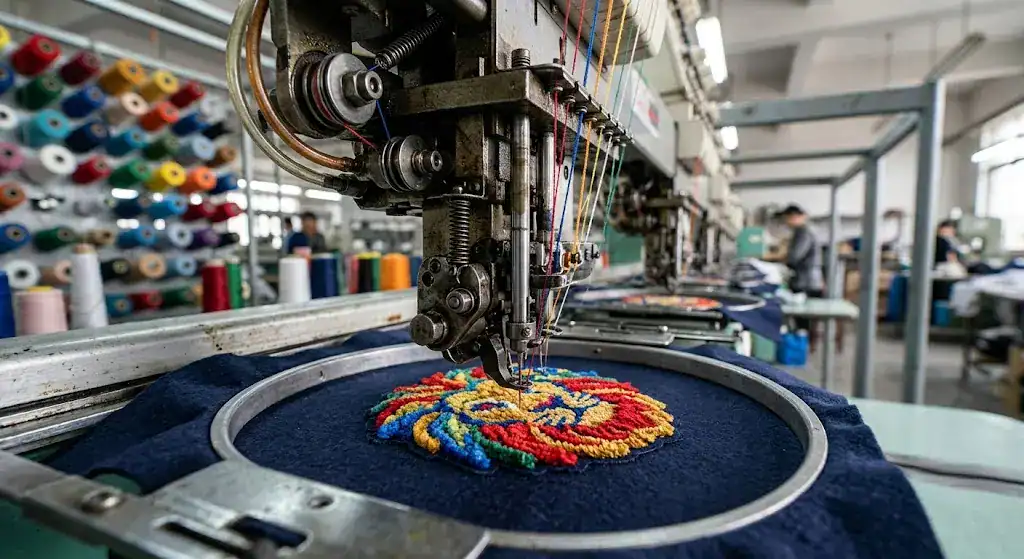
The digitizing process for a final approved design involves the use of a computer programmer who will turn the vector artwork into an embroidery file format (.DST, .PES). The translation process does not occur automatically because it involves the creation of manual stitch data by an experienced digitizing technician.
Digitizing for a chenille patch entails mapping out:
- The sections of the design to be chenille stitched versus regular flat embroidery outline
- Direction of stitching in the chenille section – determines how light falls on the surface texture
- Underlay stitches that provide foundation stitching prior to the actual stitching process
- Cutting points in the process that cause the machine to stop between different colored stitches
Stage 3 — Sample Patch Production and Client Approval
The very first physical patch made from the digital file is known as the sample patch. This is stitched using the same kind of felt backing and the same kind of yarns as are planned to be used during the mass production. This sample patch is then stitched to the sample jacket.
Evaluation criteria for the sample patch:
- How does the pile height and density look?
- Is the color correct according to your pantones?
- Do the edges have a crisp finish?
- Does the patch lay flat against the wool backing?
- Is it centered properly as per the instructions in the technical pack?
Once you receive the physical sample, inspect it for any differences between natural light and artificial light. Since chenille pile reflects light based on angles, there is a possibility of the colors appearing different than what one would expect in a photograph. Rub your fingers in opposite directions across the pile, ensuring an even density with no spots where the pile seems to be less. Check whether the back of the varsity jacket materials lies perfectly flat to the wool base and does not rise at the edges. If anything fails the inspection, please document the problem in an e-mail with photographic proof of the defect. An oral agreement or an agreement by email with no pictures creates confusion for bulk production.
Customization Options: What You Can Control
Type of Patch & Shape
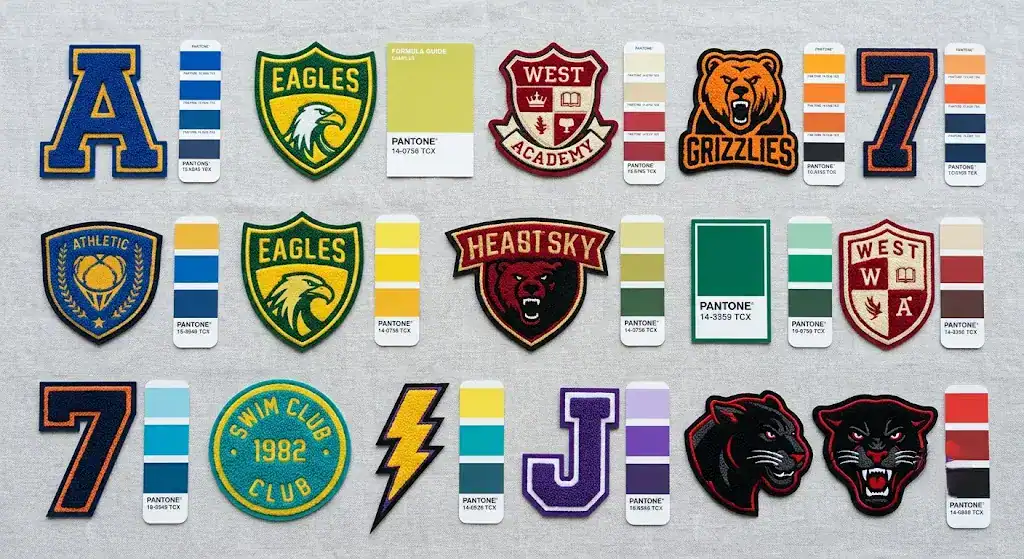
Standard letters and numbers in block, collegiate, script or full customized fonts. Customized patches in shape of crests, shields, stars, mascot, animal profile, and brands’ logo. Custom shapes follow the actual design shape and not limited to square patches.
Color Combinations
For chenille patches, each color in the design uses different yarn threads. For standard patch production, 6 colors can be used in a design although there is potential for using up to 10 in complex designs. The number increases production costs. Colors can be matched to the Pantone colors. There is provision for glow-in-the-dark threads, metallic yarn, and reflective yarn.
Patch Size
Typically, chest patches for the regular design should be around 3-4 inches in width. Back patches may have dimensions of 10-12 inches. Sleeve numbers or year patches should be about 2-3 inches.
Stage 4 — Jacket Body Production
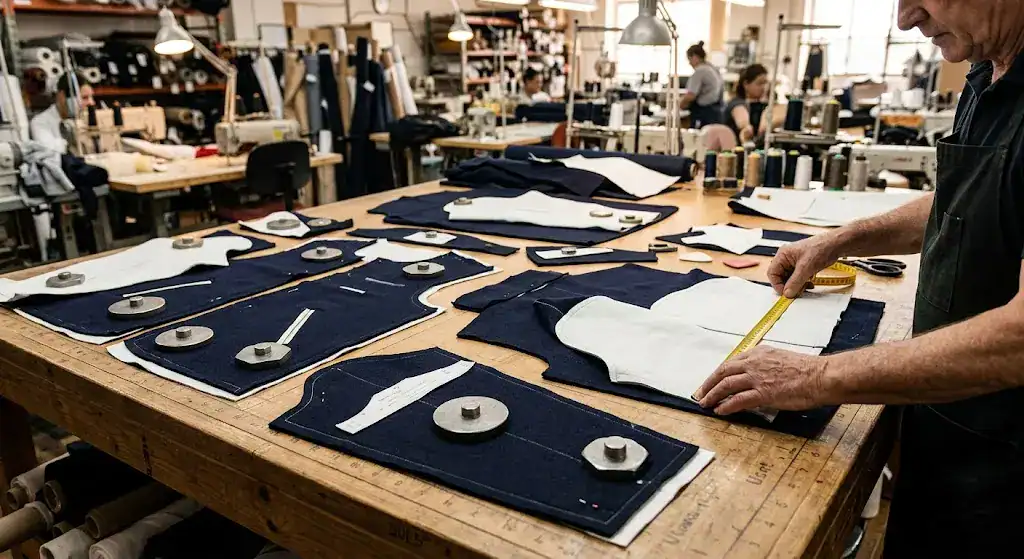
While sampling of the patches is underway, body jackets will be processed concurrently. This process requires coordination such that the mass manufacture of patches and assembling of the jacket can be completed simultaneously.
- The body is cut out from 24 oz Melton wool fabric, in the specified color with pattern pieces to reduce wastage
- The sleeves are cut from either 1.2 mm top grain cowhide leather or 100% all wool as per the specification
- The lining panels (generally quilted satin fabric), as per the specification of color or print are cut and prepared
- Rib knit collar, cuffs, and hems are made in the specified Pantone color
- All parts are bar tacked prior to final assembly
Stage 5 — Chenille Patch Attachment
The process of attaching the patch to the jacket is an essential step in the process, as it determines not only the aesthetic quality but also its longevity. There are two types of methods used to attach the patches to jackets:
Sewing Method
The felt backside of the patch is attached to the jacket using lockstitch around the edge. In the mass production, this process is carried out by experienced sewing workers based on a guide showing where to put the patch on each jacket. The sewing process produces the most durable patch, so it is always chosen when you will wear the jacket frequently and wash it.
Heat Activated Adhesive Application
The patch is attached to the jacket using heat-activated glue. It does not last long enough under regular use and washing; therefore, it is never used for production purposes.
Stage 6 — Quality Control and Final Delivery
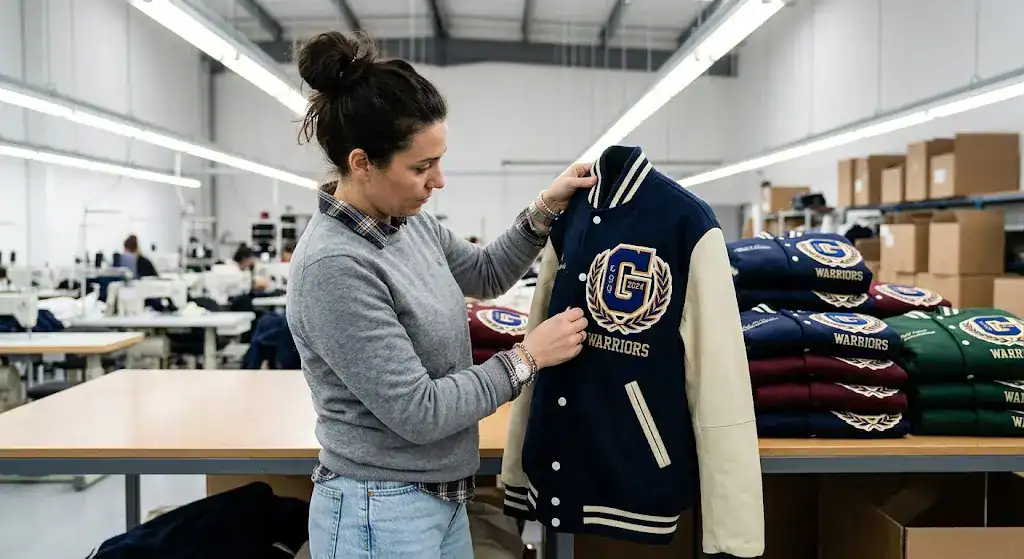
Every finished jacket goes through a structured quality control inspection before it leaves the production floor. This stage ensures that the completed garment matches the pre-production sample approved by the client, covering both the jacket body and the chenille patch in detail. Any unit that does not meet the standard is pulled from the batch and either corrected or replaced before final packing and shipment.
- Precision of patches to the technical drawing that has been approved
- Conformity in color through the whole production process: the body, sleeves, ribbing, and the patch itself
- Safety and reliability of the stitching at stress points such as pockets and the zip
- Functioning of hardware: snaps, zippers, etc.
- Attaching of the lining and labeling inside
- Level of finish compared to the pre-production sample that has been approved
Schedule: Timeline and Expectations for Design to Delivery
- Artwork preparation and conversion to digital format — 3 to 5 business days
- Produce samples (jackets and patches) — 2 to 3 weeks
- Review of client’s sample approval — 1 week
- Large-scale manufacturing — 3 to 5 weeks
- Quality control testing — 3 to 5 days
- Shipping from overseas factory — sea cargo 30 to 40 days; air cargo 5 to 7 days
10. What Should Buyers Prepare Before Ordering?
- Vector graphic file for chenille patch logo – Preferred formats are .ai or .eps
- Color samples from Pantone chart for patch yarn, jacket body, sleeves, and ribbing
- Patch size and position/positions on the jacket
- Body color choice and fabric of the sleeves
- Collar, cuffs, and bottom ribbing colors
- Sizing break down and order quantity
- Private label specifications including neck label, care label, and branded hardware
- Delivery date
Frequently Asked Questions
How is a chenille patch different from standard embroidered patch?
Standard embroidered patches lie on the surface of the cloth. In a chenille patch, looped and cut yarn forms a pile that rises 4-6 millimeters above the back material. The texture thus formed is typical of a varsity jacket.
Are chenille patches sewn or ironed on a jacket?
Sewn-on patches are produced by sewing the patch directly onto the jacket. This is done via lock stitching on the periphery of the felt material. Iron on patching can be faster but it deteriorates after repeated use and cleaning. A professional manufacturing company producing varsity jackets with patches must employ the process of sewn patches for its product.
In what format will you need the artwork?
The general requirement would be vector artwork in .ai or .eps format, specifying Pantone colors for all colors present in the design. Should your design artwork be present as a photo, drawing, or raster-based image, RaceApparelCUS offers a tech pack that makes your design artwork ready for production. The extra time needed is about 3-5 days, and it will remove the most popular reason for a rejected sample.
What is the MOQ for a custom varsity jacket with chenille patch?
The company works on the basis of MOQ of 25 pieces per colorway. In case, for example, there is a necessity to check out how your brand, school, or sports team will like the design, it is quite possible to try out the design first. In the case of personalized jackets, check if the MOQ relates to all jackets or each variant separately.
What is the maximum number of colors in a chenille patch?
For production patches, you can use up to 6 yarn colors in total. In addition, there are specialized patches using metal threads, light-emitting threads, and reflective thread, which count as separate colors. All colors will be selected based on Pantone references.
Can I use a combination of chenille patches with other types of embroidery in the same jacket?
Yes. It is very common to have a custom varsity jacket with both chenille patch for the primary logo, and flat embroidery as well as puff embroidery for text elements. Verify that all techniques used in the order are performed in-house – any mixing of in-house and outsourced production will result in inconsistent quality.
What is the duration of the production process from start to finish?
A regular order takes 30-45 days from approval of the sample to delivery. Taking into account the period of creating samples and design, the overall period required for completion of the project and delivery by international sea cargo will range between 8-12 weeks. By air cargo, it may take 5-7 days only but will be more expensive.
Is it possible to create waterproof chenille patches?
Typically, patches made of chenille are produced using synthetic acrylic yarn or natural wool yarn which are not waterproof themselves. However, it is possible to have a waterproof coating applied to both the patches and the material of the jacket around the patch upon request. This option is recommended for team jackets intended for outdoor use in rainy conditions.
RaceApparelCUS creates personalized varsity jackets with chenille patches for companies, universities, sports and social organizations. In-house chenille patches production, OEM jackets manufacturing, no minimum quantity requirement, 3-step quality check system from sample approval to pre-delivery inspection.
Get a free quote in 10 minutes — Visit our custom varsity jacket manufacturer page to review production options, request a sample, or get a free quote.
