

MOTORCYCLE JACKET SAFETY:
ADVANCED IMPACT ENGINEERING
Professional-grade protective systems featuring CE-certified armor, high-tenacity ballistic textiles, and reinforced seam technology for maximum rider survivability.
ENGINEERING MOTORCYCLE JACKET SAFETY FOR EXTREME IMPACTS
For professional racing teams and premium apparel brands, the core value of any garment lies in its motorcycle jacket safety ratings. In the event of a high-speed slide or collision, the structural integrity of the gear is the only barrier between the rider and life-altering injuries. Many B2B buyers face the challenge of sourcing gear that looks professional but lacks the internal reinforcement needed to pass modern safety certifications. Without high-denier fabrics and impact-absorbing inserts, a jacket is merely fashion apparel, leaving the rider vulnerable to road rash and skeletal fractures during an accident.
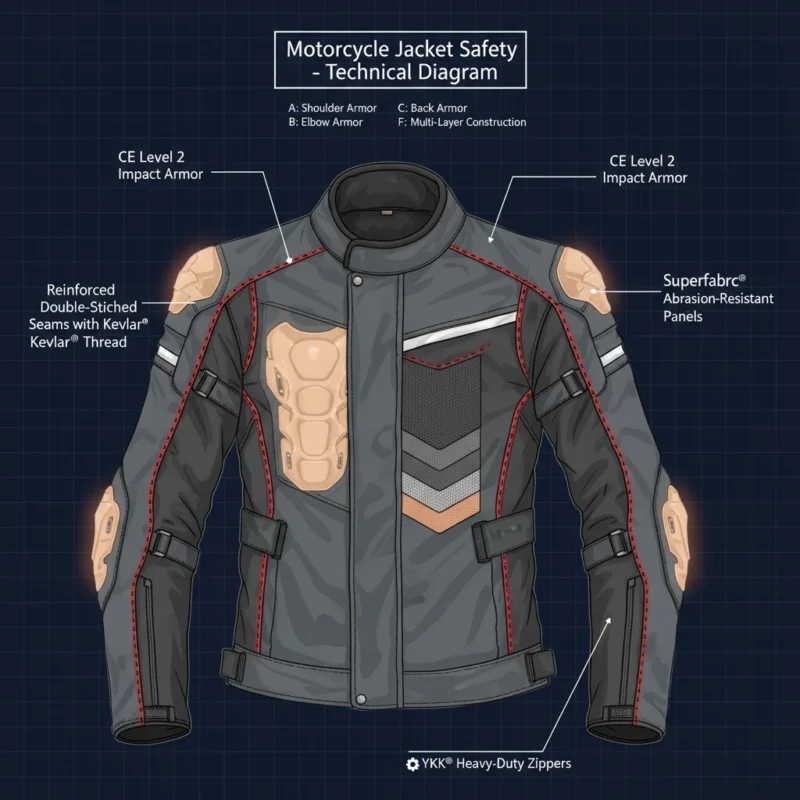
Our manufacturing solution prioritizes motorcycle jacket safety through a multi-layered defense strategy. We utilize genuine 1000D Cordura® and 1.3mm competition-grade leather as the primary abrasion barrier. Beneath this shell, we integrate pocket systems for CE Level 1 and Level 2 viscoelastic armor in the shoulders, elbows, and back. These inserts are designed to stay soft and flexible during normal riding but harden instantly upon impact to disperse energy. By reinforcing all critical “fall zones” with secondary heat-shielding aramid linings, we ensure our jackets provide the high-tier protection required for professional use.
Beyond material strength, our safety engineering includes specialized “burst-proof” construction. We use high-tensile bonded nylon threads and triple-stitching on all structural seams to ensure the jacket maintains its shape under the intense friction of a slide. This commitment to technical excellence is why our gear is trusted by B2B clients who prioritize rider welfare above all else.
Technical Standards for Professional Motorcycle Jacket Safety
Precision in motorcycle jacket safety is measured by the garment’s ability to survive the three stages of a crash: the initial impact, the subsequent slide, and the potential heat buildup. Our jackets are tested to withstand a 4.5-second slide on asphalt, far exceeding standard consumer requirements. With a seam burst strength of 35kN, our construction prevents the garment from opening during high-stress maneuvers. For B2B procurement managers, these EN-certified metrics provide the empirical evidence needed to market a truly protective product. Our 100% impact testing protocol ensures that every armor insert performs flawlessly, providing a consistent safety baseline for your entire inventory.
Safety Innovation
Innovative Materials Enhancing Motorcycle Jacket Safety
The evolution of motorcycle jacket safety is driven by the integration of high-tech textiles and ergonomic design. We don’t just add armor; we engineer the entire chassis to support the body during a crash. This includes the use of accordion stretch panels that allow the armor to stay in its correct anatomical position even when the rider is moving aggressively. By focusing on the synergy between the outer shell and the internal protective components, we create a garment that offers 360-degree protection without restricting the rider’s ability to control the motorcycle, which is a critical safety feature in its own right.
High-Tenacity Ballistic Fabrics
For the adventure and touring markets, we utilize 1000D ballistic nylons that offer a superior strength-to-weight ratio. These materials are essential for motorcycle jacket safety because they resist tearing better than traditional polyester blends. We reinforce high-impact areas like the shoulders and elbows with SuperFabric® or ceramic-coated panels that act as a “skid plate” during a slide. This prevents the fabric from catching on the road surface, reducing the risk of the rider tumbling, which is a leading cause of fractures in high-speed incidents.
Integrated Armor and Airbag Compatibility
Modern safety gear must be modular to adapt to changing rider needs. Our jackets are designed to be “Airbag Ready,” featuring expanded stretch zones that can accommodate the deployment of electronic airbag vests. Learn more about our Motorcycle Jacket Customization & Sizing → to see how we adjust patterns for these advanced safety systems. This forward-thinking approach to motorcycle jacket safety ensures that your brand is at the cutting edge of protective technology, offering your customers the highest level of security available in the 2026 market.
Regulatory Compliance and PPE Certification
Managing a safety-oriented brand requires a deep understanding of international PPE (Personal Protective Equipment) laws. According to the European Commission Safety Standards, all motorcycle apparel sold as protective must meet specific EN 17092 ratings. We provide full technical files and lab test results for all our gear, ensuring your motorcycle jacket safety claims are legally backed and ready for global retail. This transparency is vital for B2B buyers who need to navigate the complex legal requirements of the motorcycle gear industry while ensuring driver safety.
View our comprehensive lab test results for abrasion, impact, and seam strength.
Frequently Asked Questions
Frequently Asked Questions About Motorcycle Jacket Safety
Everything you need to know about CE armor levels, ballistic fabrics, waterproofing, and abrasion testing standards.
What is the difference between Level 1 and Level 2 armor in motorcycle jacket safety?
CE Level 1 armor is the standard protection level, designed to reduce transmitted force to below 35kN. Level 2 armor is thicker and denser, reducing transmitted force to below 20kN, making it nearly twice as effective at absorbing impact energy. We recommend Level 2 for high-speed track or touring gear where the risk of high-energy impact is significantly higher.
Why is triple-stitching important for a safety jacket?
In a crash, the seams are the most vulnerable point of the garment. If a seam bursts, the armor and protective fabric can move away from the body, leaving the skin exposed. Triple-stitching ensures that even if the outer thread is abraded away during a slide, the internal safety stitches keep the motorcycle jacket safety structure intact, protecting the rider throughout the entire accident sequence.
Are textile jackets as safe as leather jackets?
While 1.3mm leather remains the gold standard for absolute abrasion resistance, high-quality 1000D Cordura® textile jackets offer excellent motorcycle jacket safety for street and touring use. Textiles have the added benefit of being lighter and allowing for better ventilation and waterproofing, which reduces rider fatigue—a major factor in preventing accidents before they happen.
Can the armor in your jackets be removed or upgraded?
Yes, all our professional jackets feature internal “armor pockets” with secure Velcro closures. This allows riders to remove the armor for cleaning the jacket or to upgrade from Level 1 to Level 2 protection. This modularity is a key selling point for B2B buyers, as it allows them to offer different safety tiers within the same jacket chassis.
How do you test the abrasion resistance of the fabrics?
We use the “Martindale” and “Darmstadt” test methods, which simulate a rider sliding across a standard road surface at specific speeds. We measure how many seconds the fabric lasts before a hole is formed. For top-tier motorcycle jacket safety, we ensure our materials exceed the minimum requirements for “Class AAA” certification, the highest rating possible for motorcycle protective apparel.